
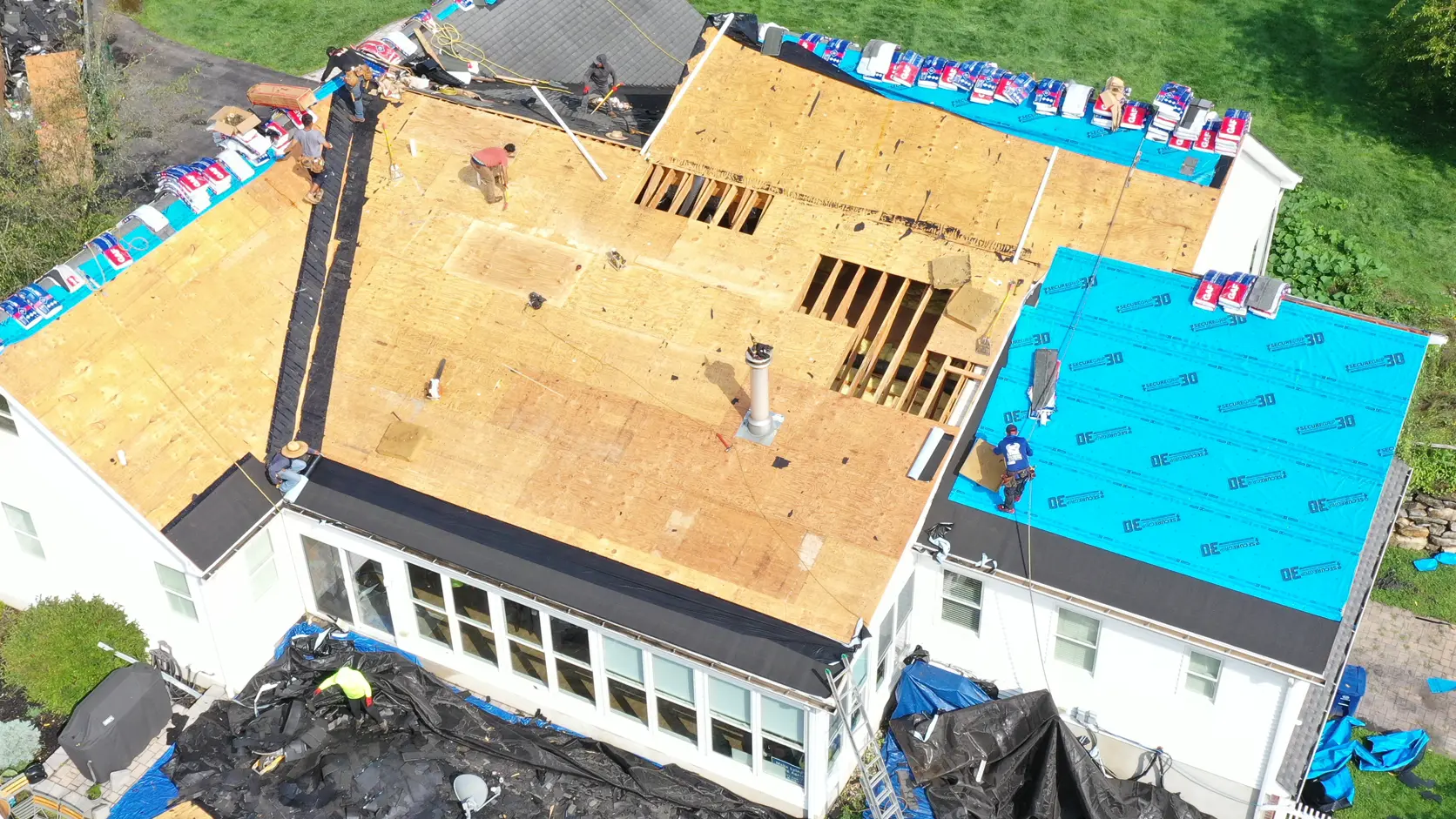
Fall is genuinely one of the better times to replace a roof in New Jersey and Pennsylvania, and the reason has less to do with the season itself than with what it lets you avoid. A fall roof replacement gets finished and fully sealed before winter’s freeze-thaw cycles and snow load put stress on the new roof, and it beats the spring rush, when every roofing company in the area is booked out for weeks.
A few things worth knowing before you schedule:
- Shingle adhesive strips need moderate temperatures to seal properly. Install too close to the first hard freeze and they may not bond until spring, leaving them more exposed to wind during the coldest months.
- Most detached one- and two-family homes in New Jersey don’t need a permit to reroof. That rule has been statewide since 2018, so there’s no red tape slowing down a fall project.
- Waiting until a leak or ice dam shows up in January usually means emergency scheduling and higher urgency pricing, not a planned replacement on your terms.
- Booking now, before the ground freezes and before crews are working around snow, gives you more flexibility on timing and crew availability.
Why the Temperature Window Matters
Asphalt shingles rely on a self-sealing adhesive strip that bonds each course to the one below it. That bond needs a run of moderate weather to set. Install shingles right before a hard freeze and that seal may not fully form until spring sun warms the roof back up, which leaves the shingles more vulnerable to wind uplift over the winter months. Early-to-mid fall in New Jersey and eastern Pennsylvania usually gives a wide enough window of good working temperatures to avoid that problem entirely.
The Permit Question
One thing that surprises a lot of homeowners: replacing the roof covering on a detached one- or two-family home in New Jersey doesn’t require a building permit. That’s been the rule statewide since March 2018, when the state reclassified routine reroofing as ordinary maintenance. It’s a different story for three-family homes, multi-unit buildings, and commercial properties, which still need a permit through the local construction office. For most single-family homeowners, though, there’s nothing standing between deciding to replace the roof and getting it scheduled.
What Happens If You Wait
Once winter sets in, a roof with any existing weakness has to survive freeze-thaw cycling, snow load, and ice damming at the eaves, all before you can get a crew back out safely. Steep, snow-covered, or ice-covered roofs are harder and slower to work on, which pushes emergency repairs later into a season when every roofing company is already stretched thin with weather calls.
Getting Started
We start every roof replacement with a full evaluation, not a sales pitch. If your roof genuinely has another season or two left in it, we’ll tell you that. If it’s showing the kind of wear that won’t hold up through another New Jersey or Pennsylvania winter, fall gives you the room to plan the work instead of reacting to it. Schedule a roof evaluation and we’ll walk you through what we see.
